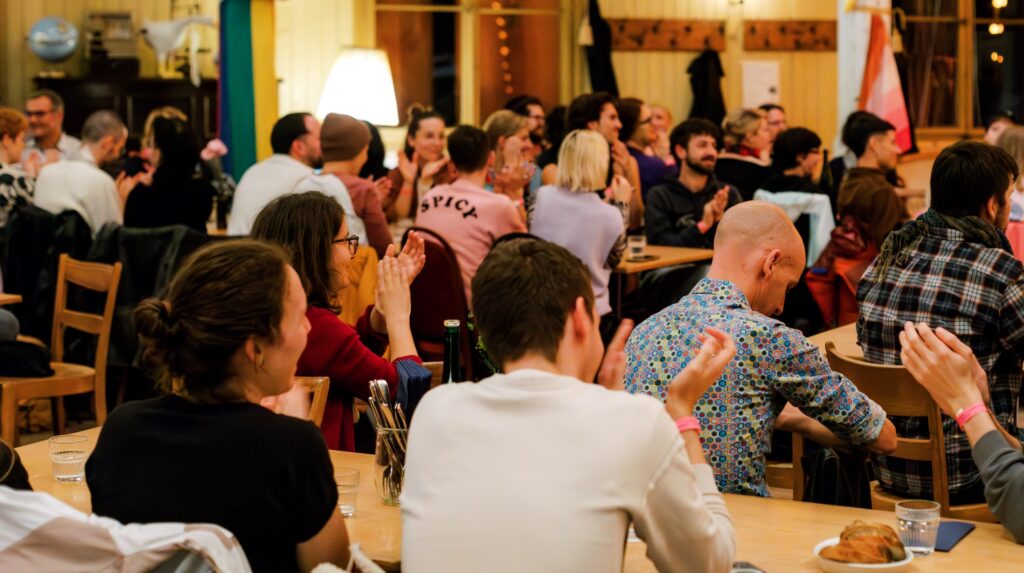
The core of the conference are the various workshops. You can book them according to your interests and put together your own daily program. The workshops are held in different languages. You can book one workshop per session.
All workshops will have break(s) – but you have the option to take your own breaks at any time.
1. Session 11:15 AM-1:15 PM
WS A1 DE: How can we build bridges between queer emancipation and anti-racist demands?
With Ahmed Ajil (RADICAL department at männer.ch)
What does it mean to experience racism in Switzerland? What forms of racism exist and how do they manifest? What does intersectionality mean in concrete terms? Where can bridges be built between anti-racist approaches and movements and the empowerment of queer people? Where are the gaps and areas of tension? In this workshop, we want to get to the bottom of these questions, critically examine ourselves, and draw hope for positive change.
WS A2 DE: Racism meets Queerness – Voices from Lived Realities
With Maximilian Grieger and Roger Furrer (kweercare) and Ömer Atesci (Pink Cross)
Racism and migration experience directly affect health, participation, and access to care – even within queer spaces. This workshop focuses on voices from lived realities: What does it mean to experience multiple discrimination, and what does that mean for care, counseling, and community work? Based on short impulses from our kweercare soirée, we will work in small groups on concrete situations from the participants’ everyday lives, identify barriers in the health and support system, and jointly develop approaches for anti-racist, queer-sensitive care practice.
WS A3 FR : Unity and Sincere Bonds
With Emmanuelle and Chantal Mariam (Mosaïk Bienne)
Collective reflection and tools to develop against racism within queer communities: In this workshop, we will collectively reflect on the destructive capacities of bonds that racism and white supremacy can produce in queer spaces. Through activities, we will develop ideas and tools to support unity, emancipation, and strong bonds within our communities.
WS A4 EN: Community Organising Beyond Borders
With Milchjugend/lila. queer Festival
How can partnerships across borders strengthen queer communities? Activists from lila. queer festival and the Prishtina Queer Festival will share the story of how their collaboration began, what helped it grow, the challenges they encountered, and the impact it has had on both organisations and the queer communities in Switzerland and Kosovo. Drawing on their experiences, participants will explore the opportunities and limits of community organising across borders and gather ideas for their own work.
WS A5 EN: Advocacy Beyond Borders
With LOS & Accept Romania
Since 1996, Accept Romania has been advocating for LGBTQIA+ rights and equality. In this workshop, representatives from Accept will share insights into their advocacy work, highlighting key successes, current challenges, and lessons learned. Together with LOS, we will explore how advocacy strategies can be shared across borders, discuss the importance of international solidarity, and reflect on the opportunities and limits of transferring experiences between different social and political contexts.
2. Session 2:45 PM-4:45 PM
WS P1 DE: Not queer enough?
With Marc, Livia (Queeramnesty) and Lea (Bi+ Schweiz)
Queer refugees are heavily affected by discrimination. Refugees from the Bi+ spectrum are particularly often confronted with prejudice and invisibility – both with authorities and within the community. Bi+ people make up almost 60% of the LGBTQIA+ community and yet often remain invisible, even in queer spaces and institutions. This workshop sheds light on personal Bi+ experiences in the context of migration and multiple discrimination. In addition, the asylum context will be examined in more detail. Together, we will discuss how (queer) spaces can be made more solidary and inclusive.
WS P2 DE: Safety for whom? Queer spaces in the tension between protection and police violence
With Alessandra Widmer and Tabea Rai (LOS)
Hate crimes are increasing, Prides are attacked, the call for more safety is loud. But safety is not the same for everyone. For some, police presence at a Pride means protection and agency. For Queers affected by racism, for Sans-Papiers, sex workers, trans people, or people without a permanent residence, the same presence means control, racial profiling, and violence. We ask: Whose safety is considered, and whose is sacrificed for it? Where is cooperation with the police pragmatically necessary, and where does it reproduce the violence it is supposed to protect against?
WS P3 FR : From Exile to Welcome: Migratory Justice Practices for LGBTIQ+ People
With Natalia Cuajy Sarrias (Asile LGBTIQ+)
After an analysis of the LGBTIQ+ asylum journey in Switzerland through the study of concrete cases, participants – divided into working groups – are invited to co-construct good practices around three axes: 1. Daily welcome: How to make our local queer spaces truly inclusive and accessible (languages, codes, free access)? 2. Advocacy & Alliance: How to politically support struggles related to LGBTIQ+ asylum without adopting a paternalistic stance? 3. Deconstructing racist and Eurocentric biases in supporting migrant people.
WS P4 FR : Intersectional Discrimination of LGBTIQ+ Refugees and Asylum Seekers in Switzerland
With Rosida Koyuncu and Marie Sigrist (InMind)
This workshop presents the main results of the participatory research project InMIND (Intersectionality, MINoritization and Discrimination), dedicated to the intersectional discrimination experienced by LGBTIQ+ refugees and asylum seekers in French-speaking Switzerland, particularly in residential spaces. Through the research results, a reflection on migratory justice and anti-racism within the queer community, as well as excerpts from the film InMIND – Je suis qui ?!, the workshop brings together research, lived experiences, and audiovisual creation to collectively reflect on more inclusive practices.
WS P5 EN: Mapping and Addressing Spanish-Speaking Queer Communities in Switzerland
With Apolonio Huerta, Former Chair Zurich Chapter of Democrats Abroad
From Latin-American expats to marginalized immigrant workers; queer communities with ties to Hispanic or Latinx cultures are diverse, socially strongly linked yet politically oftentimes underserved. This guided roundtable aims to map lived realities of queer people who organise and socialise under these umbrellas as well as their relationships to existing formats of political and queer organising. For People of these communities, plus other activists looking to better address the needs of said groups.
–


